Credit Report Explained — Read All 5 Sections Like an Underwriter
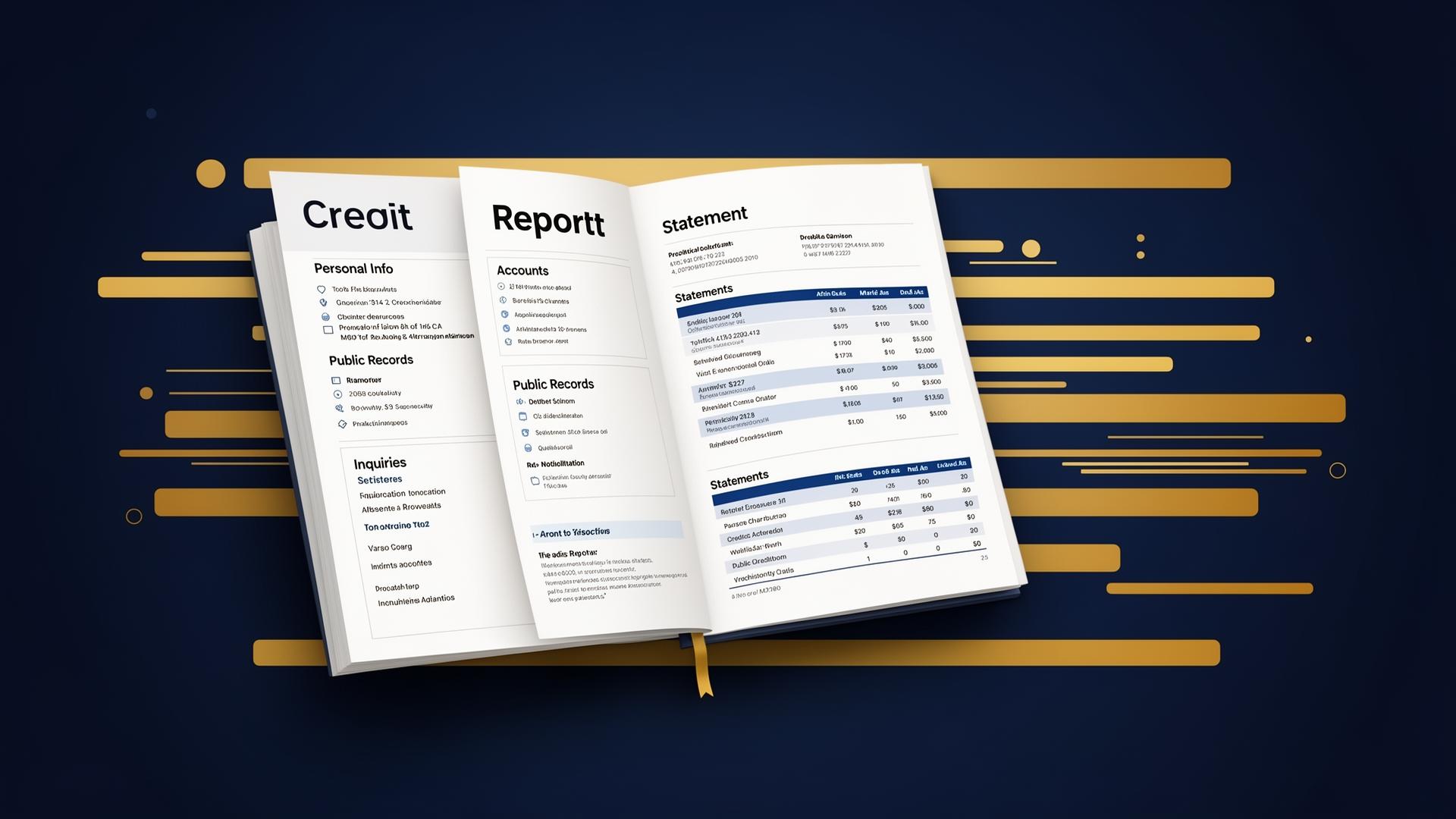
Your credit report is the file. Your credit score is the grade calculated from it. Knowing how to read every section of the file — personal info, accounts, public records, inquiries, statements — is how you spot the errors dragging your grade down.
Important Legal Notice
The information on this site is for informational and educational purposes only. It does not constitute legal, financial, credit, or professional advice. Comparisons, pricing, and recommendations are subject to change without notice. Verify current terms directly with the provider before making decisions. Credit results vary by individual. Consult a qualified advisor for personalized guidance. We assume no liability for decisions made based on this content.
What is a credit report?
Per the Consumer Financial Protection Bureau, a credit report is the master file maintained by each of the three nationwide consumer reporting agencies (Equifax, Experian, TransUnion) containing every account, payment, inquiry, public record, and identifying header tied to your Social Security Number or ITIN.
Section 1 — Personal information (identifying header)
Legal name, every alias (maiden, hyphenated, misspelled), every address you've ever put on a credit application, SSN or ITIN suffix, date of birth, employers reported on credit apps. This section doesn't affect your score directly — but errors here cause merged files and denied applications. Dispute every variation that isn't yours.
Section 2 — Account history (tradelines)
The biggest section. Every credit card, mortgage, auto loan, student loan, personal loan, and credit-builder line with your name on it. Each tradeline shows:
- Creditor name + masked account number
- Date opened (drives your length-of-history score factor)
- Credit limit or original loan amount
- Current balance + reported as-of date
- Payment status by month for the prior 24 months
- Account status — open, closed in good standing, charged off, in collection
Section 3 — Public records
Since the 2017 National Consumer Assistance Plan, only bankruptcies remain on standard credit reports — civil judgments and most tax liens were removed nationwide. Chapter 7 bankruptcy stays 10 years from filing; Chapter 13 stays 7 years from filing.
Section 4 — Inquiries
Hard inquiries: you applied for new credit. Visible to lenders, on file for 2 years, scored for ~12 months. Soft inquiries: your own pulls, prescreens, employer/landlord checks, your own monitoring service. Visible only to you, zero score impact.
Section 5 — Consumer statements
You can add a free 100-word statement to your file explaining a disputed item, an identity-theft event, or a one-time hardship. Lenders rarely read it — but it's the only place where you can put your own words on the file.
How the 3 bureaus actually differ
| Bureau | Strongest data set | Most commonly pulled by |
|---|---|---|
| Experian | Credit cards, auto loans | Most credit card issuers, FICO mortgage |
| Equifax | Mortgage, employment data | Mortgage lenders, employers |
| TransUnion | Auto loans, rentals | Apartments, auto finance |
Read all 3 credit reports daily — and catch every error
$1 for 15 days — then choose monthly, quarterly, or yearly. Cancel anytime.
- 3-Bureau credit reports & scores
- Daily monitoring & alerts
- Identity theft protection
- Score simulator & insights
- $1 for 15 days trial
- Cancel online anytime
- 3-Bureau credit reports & scores
- Daily monitoring & alerts
- Identity theft protection
- Score simulator & insights
- $1 for 15 days trial
- Cancel online anytime
- 3-Bureau credit reports & scores
- Daily monitoring & alerts
- Identity theft protection
- Score simulator & insights
- $1 for 15 days trial
- Cancel online anytime
Where to get your credit report free
- AnnualCreditReport.gov — federally mandated, free every 12 months from each bureau.
- Your card issuer — most major issuers offer a free monthly report or score from one bureau.
- MyITINCredit daily monitoring — all 3 bureaus refreshed every 24 hours during your $1 / 15-day trial.
How to dispute an error (free, 30-day clock)
- Pull all 3 bureaus the same week so timelines align.
- Identify the highest-impact error (wrongly reported late, debt past 7-year limit, duplicate collection).
- File the dispute online with the bureau showing the error.
- Attach supporting documents (statements, payoff letters, identity-theft affidavit).
- Bureau has 30 days under the FCRA to investigate.
- Escalate unresolved disputes to CFPB Complaint Portal.
Related credit education guides
- ITIN credit report — full walkthrough →
- SSN credit report — full walkthrough →
- How to dispute credit report errors →
- Credit score ranges decoded →
Credit report and monitoring tools
Personal Loan Offers
See loan options from trusted partners based on your credit profile.
Credit Builder Cards
Designed to help establish or improve your credit history.
Credit Card Offers
Explore cards that match your credit standing and goals.
Get an ITIN Number
Learn how to apply for or renew your ITIN today.
Bank Account Options
Access checking and savings accounts from reputable institutions.
Simply Approved Mortgages
ITIN-friendly home financing from Simply Approved Mortgages, a Simply Approved Corporation brand.
Frequently asked questions about credit reports
Start your credit monitoring today
$1 for 15 days — cancel anytime.