How Credit Scores Work — The 300–850 System Explained End to End
Your credit score is a 3-digit summary of how reliably you've repaid debt — but the system behind the number is more nuanced than most articles admit. Here's exactly what the bureaus collect, how FICO and VantageScore transform it into the 300–850 number, and what each lender does with the result.
Important Legal Notice
The information on this site is for informational and educational purposes only. It does not constitute legal, financial, credit, or professional advice. Comparisons, pricing, and recommendations are subject to change without notice. Verify current terms directly with the provider before making decisions. Credit results vary by individual. Consult a qualified advisor for personalized guidance. We assume no liability for decisions made based on this content.
What is a credit score, exactly?
The Consumer Financial Protection Bureau defines a credit score as a numeric prediction of how likely you are to repay borrowed money on time — specifically, the likelihood of going 90+ days delinquent on a new account within the next 24 months. The number is produced by a scoring model (FICO or VantageScore) from the data in your credit report. Higher = lower predicted risk = lower APR offered.
The data pipeline — how a payment becomes a score
- Creditor reports monthly — your card issuer, lender, or loan servicer sends account data to one or more of the three bureaus on a 30-day cycle.
- Bureau updates your file — Equifax, Experian, and TransUnion each maintain a separate file keyed to your SSN or ITIN.
- A lender requests a score — they specify which model (FICO 8, VantageScore 4.0, FICO Mortgage 2/4/5, etc.) and which bureau.
- The model runs on that bureau's snapshot — outputs a 300–850 number.
- The lender prices your offer — based on which tier your score falls into.
The 5 factors that drive your credit score
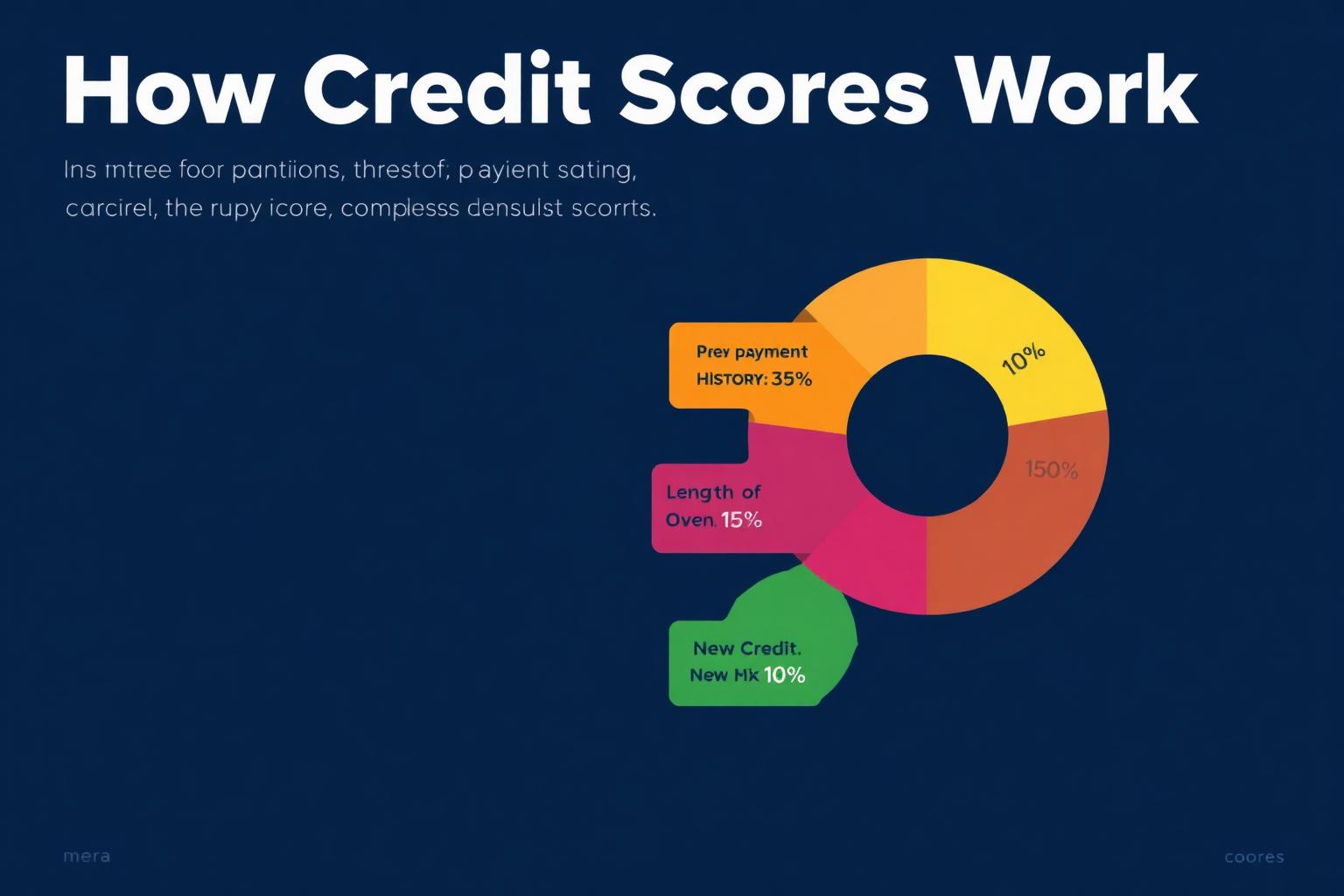
FICO publishes the weights of its five inputs. VantageScore uses slightly different terminology but similar weights. Memorize these — every improvement strategy maps to one of them.
| Factor | FICO weight | What it measures |
|---|---|---|
| Payment history | 35% | On-time vs late, severity, recency |
| Amounts owed (utilization) | 30% | Reported balances vs limits |
| Length of credit history | 15% | Average age + age of oldest account |
| Credit mix | 10% | Revolving + installment variety |
| New credit / inquiries | 10% | Hard pulls + brand-new accounts |
Payment history (35%)
A single 30-day late payment can drop a 780 by 80–110 points. Damage scales with how recent the late is and falls off after 7 years. Autopay the minimum on every account — pay extra manually.
Credit utilization (30%)
Calculated per-card and aggregate. Under 10% is optimal. The reported balance — captured the day your statement closes — is what's scored, not the daily average. Paying before statement date is the fastest legal score hack.
Length of credit history (15%)
Closing your oldest card drops both average age and oldest age. Authorized-user tradelines inherit the primary account's age.
Credit mix (10%) and new credit (10%)
Revolving + installment outperforms revolving alone. Hard inquiries cost ~5 points each and roll off FICO scoring after 12 months.
See your score from all 3 bureaus and track every factor
$1 for 15 days — then choose monthly, quarterly, or yearly. Cancel anytime.
- 3-Bureau credit reports & scores
- Daily monitoring & alerts
- Identity theft protection
- Score simulator & insights
- $1 for 15 days trial
- Cancel online anytime
- 3-Bureau credit reports & scores
- Daily monitoring & alerts
- Identity theft protection
- Score simulator & insights
- $1 for 15 days trial
- Cancel online anytime
- 3-Bureau credit reports & scores
- Daily monitoring & alerts
- Identity theft protection
- Score simulator & insights
- $1 for 15 days trial
- Cancel online anytime
Why you have multiple credit scores at once
You don't have "a" credit score — you have dozens. Two scoring brands (FICO, VantageScore) × multiple versions each (FICO 8, FICO 9, FICO 10T, VantageScore 3.0, 4.0) × three bureaus (Equifax, Experian, TransUnion) × industry-specific variants (Auto, Bankcard, Mortgage) = roughly 40+ possible numbers from the same person's credit reports. The one that matters is the one your specific lender pulls at the moment of application.
We wrote an SSN-specific version of this guide with the key nuances and differences.
Read guideITIN vs SSN scoring — same system, different starting point
Credit bureaus build a file on whichever taxpayer ID is reported. An ITIN file is scored by the same models on the same scale — but typically with a longer warmup. VantageScore 4.0 scores an ITIN file as early as month 1; FICO usually waits until month 6+. The IRS confirms ITINs are intended for federal tax filing, but lenders increasingly accept them as primary borrower IDs.
How fast can your credit score change?
Most updates post within 30–45 days of a creditor's monthly report. With daily 3-bureau monitoring you'll see changes the moment a new tradeline, balance update, or hard pull is reported. Three timeline benchmarks:
- 1 cycle (30 days): Pay maxed card under 10% → 20–50 points.
- 3 cycles: Removed inaccurate collection → 50–100 points.
- 6 cycles: Brand-new positive history materially scoreable.
Related credit-education guides
- FICO score explained →
- VantageScore 4.0 explained →
- VantageScore vs FICO compared →
- Credit score range 300–850 →
- How to improve your credit score →
Track every credit score factor in one dashboard
Personal Loan Offers
See loan options from trusted partners based on your credit profile.
Credit Builder Cards
Designed to help establish or improve your credit history.
Credit Card Offers
Explore cards that match your credit standing and goals.
Get an ITIN Number
Learn how to apply for or renew your ITIN today.
Bank Account Options
Access checking and savings accounts from reputable institutions.
Simply Approved Mortgages
ITIN-friendly home financing from Simply Approved Mortgages, a Simply Approved Corporation brand.
How credit scores work — frequently asked questions
Start your credit monitoring today
$1 for 15 days — cancel anytime.